
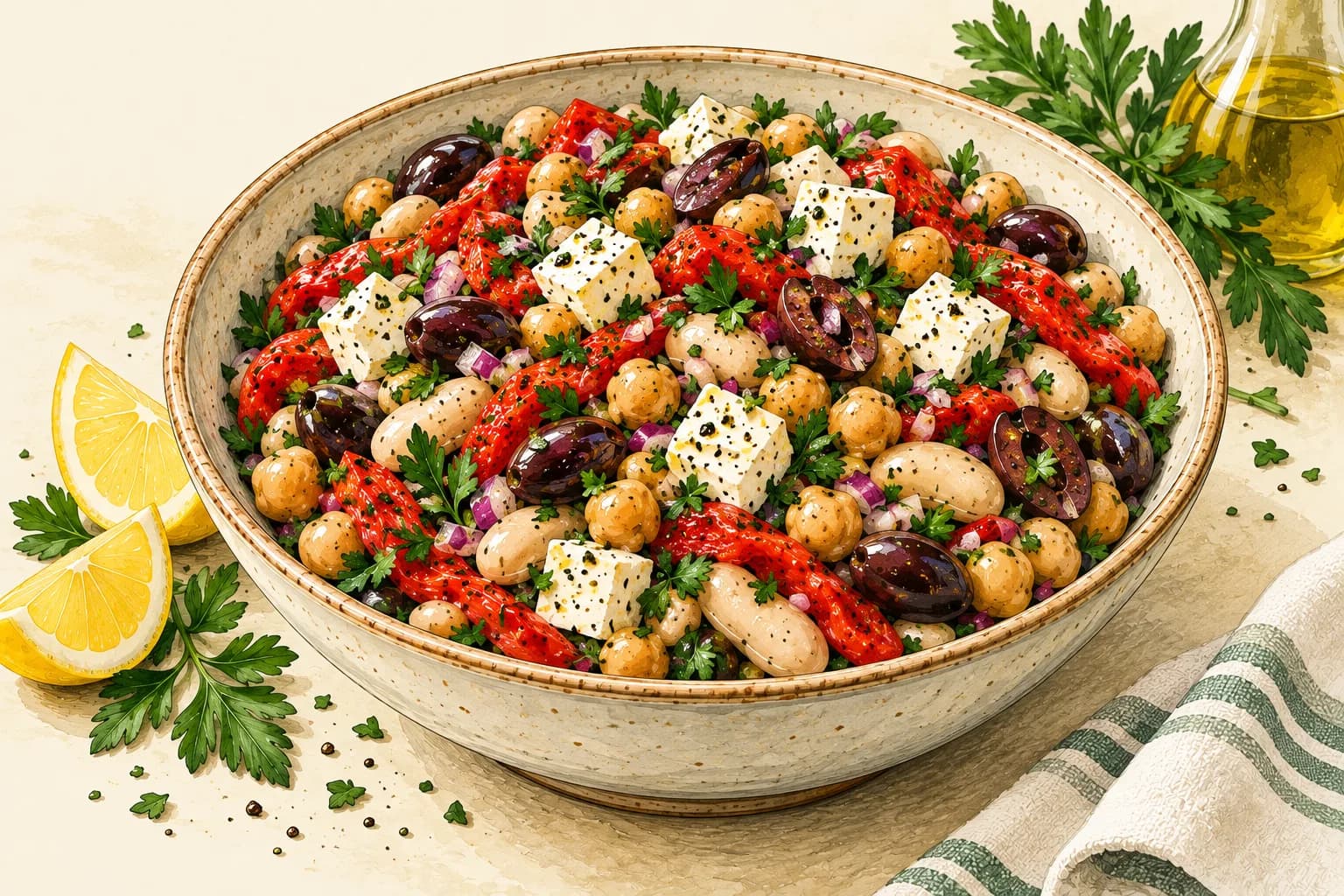
Bean Salad · Mediterranean-inspired
Mediterranean Dense Bean Salad
A make-ahead bean salad built from two kinds of beans, roasted peppers, and feta, dressed assertively enough to actually hold up — and improve — over several days.
- Prep
- 20 min
- Total
- 50 min
- Servings
- 6 (as a light main; stretches to 8 as a side dish)
For the dressing
- 6 tbsp / 90ml extra-virgin olive oil
- 3 tbsp / 45ml red wine vinegar
- 1 tbsp / 15ml fresh lemon juice
- 1 small clove garlic, finely grated
- 1 tsp / 2g dried oregano
- ½ tsp, plus more to taste fine sea salt
- freshly ground, to taste black pepper
For the salad
- ½ small red onion, very thinly sliced
- 15 oz / 425g canned chickpeas, drained and rinsed
- 15 oz / 425g canned cannellini beans, drained and rinsed
- 1 cup / 200g jarred roasted red peppers, drained and sliced into thin strips
- 0.5 cup / 75g pitted Kalamata olives, halved
- 5 oz / 150g feta, cut into small cubes — not crumbled
- 0.25 cup / 10g fresh flat-leaf parsley, roughly chopped
- 2 tbsp / 5g fresh dill, roughly chopped (optional)
- ½, diced English (or Persian) cucumber, add per portion just before serving, not to the whole batch (optional)
- Put the sliced onion in a large bowl with the vinegar and lemon juice. Let it sit for 10 minutes while you get everything else ready — this takes the raw edge off before it ever meets the beans.
- Whisk the olive oil, garlic, oregano, salt, and pepper into the onion and vinegar to finish the dressing.
- Add the chickpeas, cannellini beans, roasted peppers, and olives to the bowl. Toss well, making sure the dressing actually reaches the bottom of the bowl and not just the top layer.
- Fold in the feta gently, so the cubes stay mostly intact rather than breaking apart into the dressing.
- Cover and refrigerate for at least 30 minutes, and up to several days. Stir in the parsley and dill right before serving, along with the cucumber if you're using it.
Most dressed salads are a countdown. Lettuce wilts and cucumber weeps, and by day two the whole bowl is closer to salad soup than salad. This one runs the other way. Give it time in the fridge and it gets better, not worse — the dressing settles into the beans and vegetables instead of pooling under them. That's the whole logic behind what's often called a dense bean salad now: leave out anything that leaks water under dressing, and the usual soggy-salad complaint mostly stops applying here.
Why it actually holds up
Leafy greens and raw cucumber are mostly water held inside cell walls that dressing slowly breaks down — that's the actual mechanism behind a soggy potluck salad, not bad luck. Beans don't share that problem. They're dense and starchy, so instead of leaking liquid into the dressing, they absorb it, the way a cooked grain does once it's off the heat. Jarred roasted peppers and olives are already past the point where they'd give up water. Both were cooked or brined long before they reached this bowl, so their texture barely shifts over several days. Feta behaves differently again. Cubed and worked into the dressing early, it softens gently at the edges and picks up real tang within a few hours. Crumble it too small, though, and it turns to paste instead of holding its shape. That's why this recipe asks for cubes, not crumbles.
What's essential, what's optional
The two beans and the dressing are load-bearing. Everything else earns its place, but nothing else here is irreplaceable.
Cucumber is the one classic bean-salad ingredient left out here on purpose. It's the main reason bean salad has a soggy reputation in the first place. Cut cucumber is roughly 95% water, and once salted or dressed, it wrings itself out like a squeezed sponge. Want the crunch anyway? Add it raw and diced, just before serving, only to the portion you're actually eating that day. Stir it into the whole batch instead, and you've defeated the point of a salad built to last.
Dill is genuinely optional. Parsley isn't strictly required either, but it's the only fresh, uncooked note in a salad built almost entirely out of canned and jarred ingredients. Worth keeping unless you're out of it. Either way, add both right at the end. Delicate herbs go dark and limp fast in an acidic dressing, and there's no upside to dressing them hours before anyone eats them.
The onion is a smaller judgment call. Left raw, a few slices can dominate a forkful. Give the onion ten minutes alone in the vinegar and lemon juice before the rest of the dressing goes in. That sharp bite rounds out into something closer to pickled. It costs nothing but time you're already spending on the dressing. If you'd rather mellow the onion by roasting it instead, the Mediterranean Farro Salad uses that technique.
The dressing
A basic vinaigrette runs about three parts oil to one part acid. This one doesn't. It's closer to three parts oil to two, deliberately more assertive than you'd want on a bowl of tender lettuce. Beans taste flat on their own, and there's a lot of surface area here for a mild dressing to disappear into. Garlic and dried oregano back up the acid rather than replacing it — neither does much for texture, but both keep the dressing from tasting like plain oil and vinegar once it's spread across two cans of beans.
Salt matters more here than in most salads, and not only for flavor. Beans straight from the can taste flat until they're properly seasoned. A dressing that tastes slightly too sharp on its own usually turns out right once it's tossed through a full bowl of them. Taste again after the beans go in — not just at the whisk.
Make-ahead and storage
This is a salad meant to be made ahead — that's the point, not a compromise. Refrigerate it within two hours of assembling, covered, at 40°F/4°C or below. It's genuinely better after 6–24 hours than it is fresh, once the beans have had time to actually take on the dressing. Kept cold, it holds up well for up to four days — standard guidance for a dressed, refrigerated dish like this one. Add fresh herbs and any cucumber to individual portions as you go, rather than mixing them into the whole batch ahead of time. They're the two ingredients here that actually lose something over multiple days.
What to swap, what not to
Great northern or butter beans work in place of cannellini with no real loss — similar creamy texture, similar behavior in the dressing. Chickpeas are harder to replace without changing the salad's character; they're the firmest, most distinct texture in the bowl. Green olives can stand in for Kalamata if you want a sharper, less winey brine, though the color and flavor both shift noticeably. Feta is the one ingredient without a clean substitute here. A plant-based alternative won't soften and tang the same way over several days, so treat that swap as a different salad, not a like-for-like replacement. For a cold, make-ahead salad built on pearl couscous and lentils, see the Couscous, Lentil and Chickpea Salad with Cranberries.
To serve
Six servings as a light main with warm flatbread or crusty bread alongside; eight as a side dish. It doesn't need lettuce underneath it, and it doesn't need much done to it to look finished on a plate. The peppers and feta already carry the color; it doesn't need help. For a chopped vegetable salad that is meant to be served fresh rather than improved in the refrigerator, see the Turkish Shepherd's Salad.